


Christopher Moraff said he still remembers the first wound he saw, the first mysterious little black scab on someone’s skin. It was 2018.
“I didn’t know what it was,” said Moraff, a narcotics journalist and founder of PAGroundhogs, a drug monitoring organization.
It wouldn’t be the last. These little pockets of cell death, which could grow and get infected if left to fester, would emerge on the flesh of more and more people using opioids in Philadelphia and spread through the continental United States over the following years. The wounds were especially perplexing because they could appear far from the injection site and, even more bizarrely, on the skin of people who’d smoked or snorted opioids.
The culprit was xylazine, an animal tranquilizer that had been used as an opioid adulterant in Puerto Rico since at least the early 2000s. It had actually made its way into Philadelphia only a few years later, but really took off in the city and beyond in the late 2010s. Cutting fentanyl, heroin, or a combination of the two with xylazine would come to be called “tranq dope.” The combination was enticing to some people, Moraff said, because it gave fentanyl “legs” – a longer high.
The downside isn’t just the wounds. Xylazine appears to complicate overdose treatment, and it’s a potent sedative in its own right, leaving people who use it at an increased risk of assault. By late 2024, xylazine was detected in over half the samples submitted from across the nation to the University of North Carolina Chapel Hill’s Opioid Data Lab. The disturbing wounds xylazine inflicts, and the stupor it leaves users in, earned it the moniker of “zombie drug.”
But after a dramatic rise, xylazine use is falling, which experts say has been driven by states scheduling it as a controlled substance and the organic ebbs and flows of the drug market itself. Xylazine maintains a smaller but substantial presence now, and its legacy looms large, having paved the way for another opioid adulterant with devastating health risks, medetomidine.
This is a look into xylazine’s quieter presence today. It’s also an examination of the lessons it taught, and an attempt to peek through the door it opened into the future.
The trends today
As with any drug, the story of xylazine is a patchwork of local scenes. It’s hard to zoom out the lens, but one person who’s tried is Nabarun Dasgupta, a Senior Scientist at the University of North Carolina Chapel Hill who runs its Opioid Data Lab.
He showed Noir News a graph representing thousands of fentanyl samples taken from across the country over the past few years. The data tells a clear story: xylazine use grew through 2023 and 2024. But by 2025, it began declining sharply, and that trend has continued through 2026.
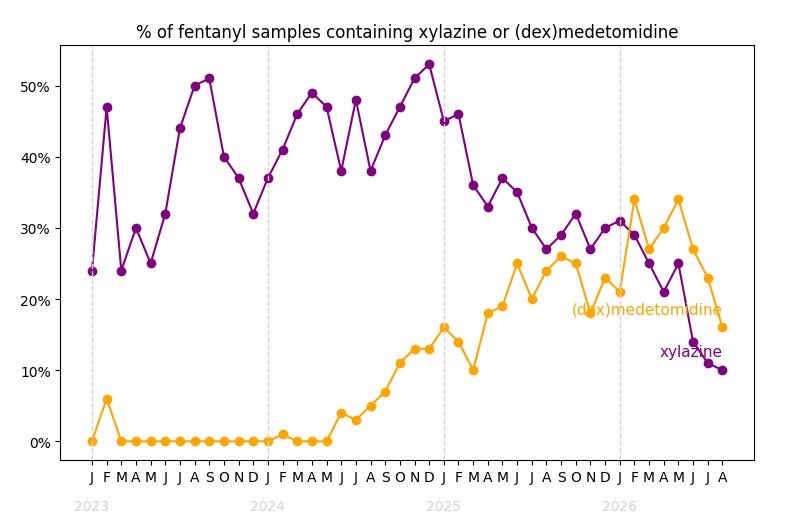
Dasgupta cautioned that despite the data’s large sample size, it shouldn’t be considered perfectly generalizable due to the fact that people are more likely to submit fentanyl samples that cause “unexpected reactions.” Nonetheless, the data on xylazine’s trajectory is telling.
“My individual professional opinion is that it’s on its way out,” Dasgupta said. “But what we see historically is that there will be lingering amounts that stick around.”
Several harm reduction and health care professionals provided Noir News perspectives that aligned with the data Dasgupta has garnered, with some added nuance from their work on the ground.
Between 2023 and 2024, clients “were coming into our drop-in center for wound treatment or for help for wound care kits. They were using xylazine, and you could tell the wounds were pretty bad,” said Bakari Atiba, Director of Community Engagement at Charm City Care Connection in Baltimore.
But in the last 18 months, xylazine has “kind of died down,” Atiba said. It’s not always clear what clients have been using since many are injecting multiple substances, but far fewer have been coming in with wounds associated with tranq dope, Atiba added.
Likewise, Dr. Nathan Menke, Clinical Assistant Professor at the University of Michigan Medical School, said he’s noticed a downward trend in xylazine prevalence among patients since 2025.
“A third to a half of our patients were testing positive for xylazine,” Menke said. “And now we’re seeing it maybe one in 10 times, I would guess.”
Dr. Brent Rau, medical director of the emergency department at Allegheny General Hospital in Pittsburgh, noted an even starker drop off.
“I haven’t had a xylazine patient that I’ve taken care of, a patient that I suspected xylazine on, for probably several months,” Rau said.
As Dasgupta noted, xylazine’s trajectory has varied with geography and local markets. In much of the West Coast, there isn’t much of a story to tell, as tranq dope never took off there.
“In Washington State, and specifically King County – I can speak most to King County – we really never saw the same levels of xylazine in our community as other areas, like on the East Coast, particularly in Philly,” said Amanda Kerstetter, a Harm Reduction and Substance Use Specialist at Evergreen Treatment Services.
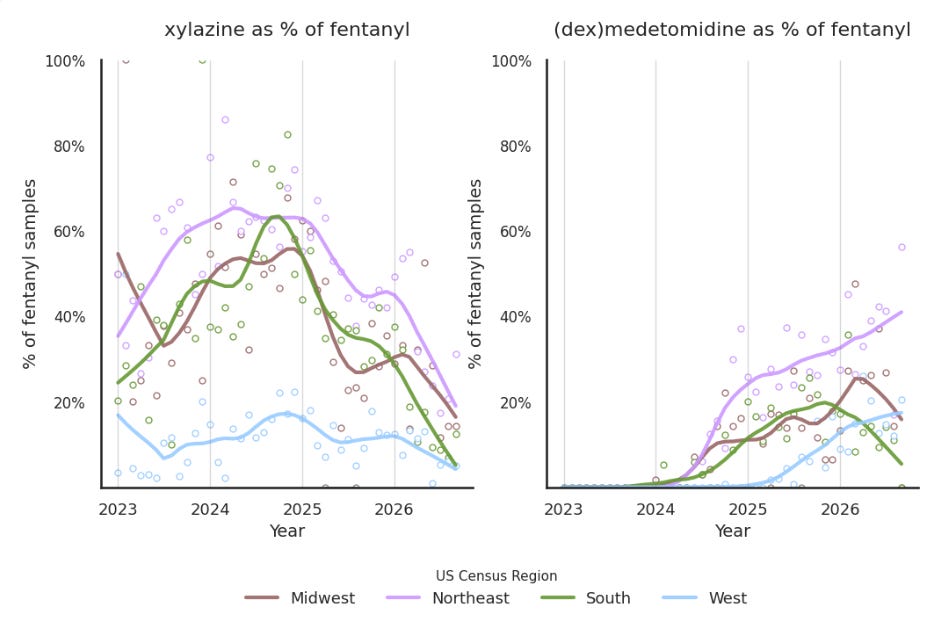
Meanwhile, Rich Vargas, Director of Outreach and Engagement of Chicago’s West Side Heroin/Opioid Task Force, has noticed an uptick in xylazine’s presence along the Chicago Avenue corridor from the clients he’s spoken with and the samples he’s collected.
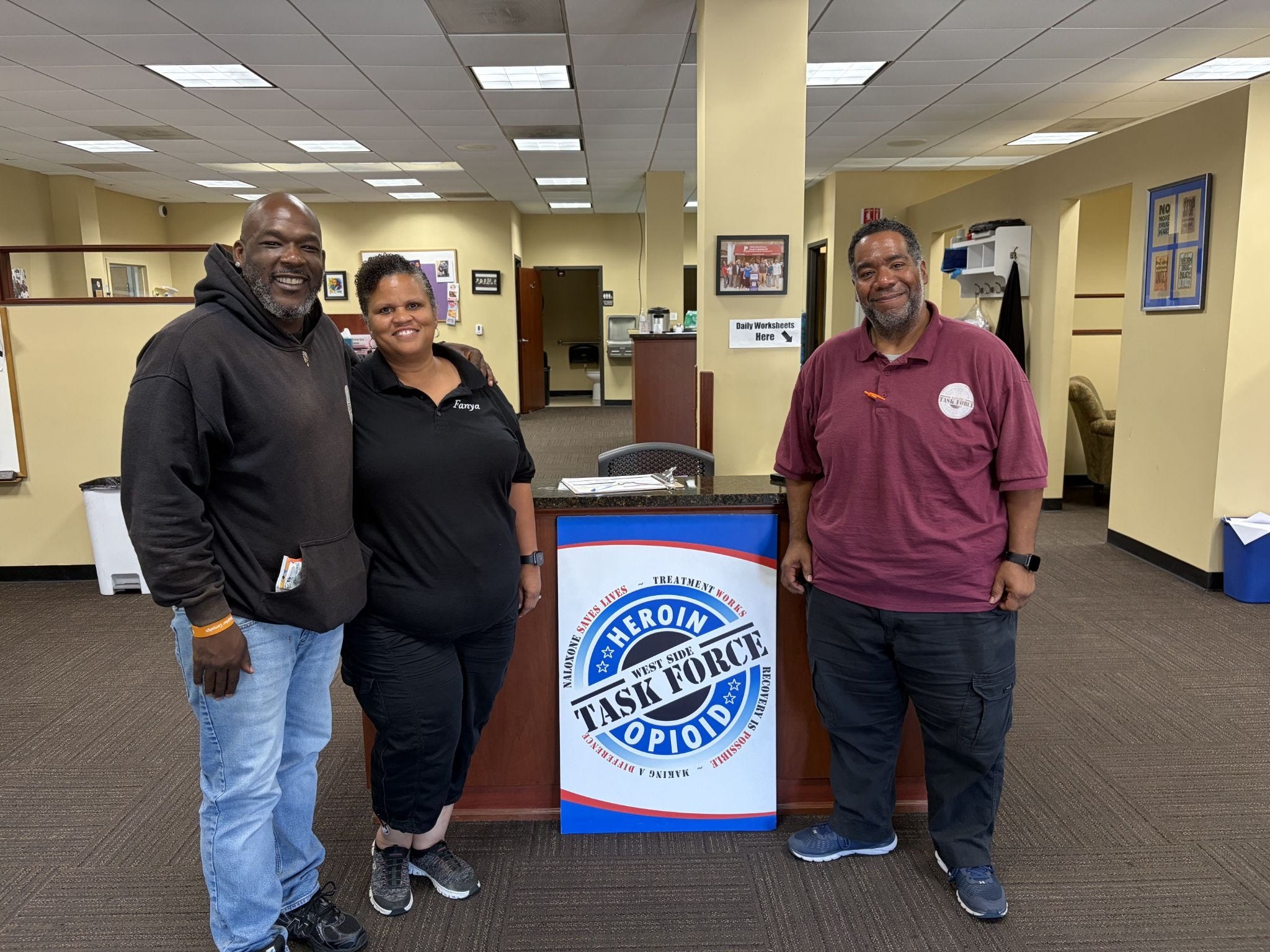
“No matter where we are, he’s forever getting a sample from somewhere,” fellow Task Force member Synque Adams said about Vargas. “You will see him.”
Several states have added xylazine to their lists of scheduled substances, which sources said has been a driving factor in its decline. But the decline may also have been driven by market forces in the illicit drug trade.
“Markets do make mistakes, and drug manufacturers, I think, have realized that the skin wounds for xylazine were just too horrific and were probably affecting their bottom line,” Dasgupta said.
And they really could be horrific. During xylazine’s peak, Atiba said some clients delayed receiving medical care due to the stigma they’d previously experienced in medical settings.
“By the time they finally do get the treatment, it’s so bad,” Atiba said. “It’s been a few cases where amputation was the only course of action.”
Menke likewise said he treated patients who postponed treatment due to stigma, and added that tending to the wounds associated with xylazine could be especially tricky.
“They form this black eschar covering the wounds, and it makes it very, very difficult for them to heal,” Menke said. “So we had patients that would require skin grafts because of the extent of those wounds.”
Lessons learned
Xylazine’s rise and fall as an opioid adulterant came so fast that scientists have only recently started getting their arms around the drug’s properties. It was originally reported that naloxone, the active drug in Narcan, had no impact on reversing the effects of xylazine because it’s a non-opioid sedative. But since then, Dasgupta and other scientists found naloxone does appear to reverse its effects to some extent (though the clinical impact on humans hasn’t been quantified), and that xylazine acts on one subtype of opioid receptor.
That finding complicates how experts thought about xylazine for years. There were countless articles and academic papers describing the drug as a “non-opioid” sedative or tranquilizer as it grew in popularity. While xylazine’s main mechanism for producing sedation is indeed distinct from opioids like heroin and fentanyl, the “non-opioid sedative” shorthand doesn’t fully capture the drug’s activity.
This also has implications for understanding the wounds and why they can seemingly appear at random on the skin. Dasgupta and other scientists had theorized about the mechanism for some time, and a published paper evidenced their suspicions. It showed xylazine acts on opioid receptors present in the skin, and this “inhibits wound healing,” Dasgupta wrote in an email to Noir News.
Xylazine’s disruption of healing “is more pronounced in the presence of fentanyl,” Dasgupta added.
While xylazine has presented many challenges for harm reduction workers, it’s also pushed them to adapt in ways that will continue to benefit communities for the foreseeable future, said Azrael Ní Mháille, a harm reduction professional who recently served as program director of Victory Programs and sat on several substance use-related government boards in Massachusetts.
“One of the first things that [xylazine] meant was a stronger push for drug checking, which is always good,” Ní Mháille said. “But it also really forced us to interrogate both our street first aid and wound care practices across the country.”
Beyond xylazine’s direct impact on public health, it may also be remembered as a trailblazer of sorts, having created a market for similar sedative opioid adulterants. When states started scheduling xylazine, it didn’t kill the supply of tranq dope, but it drastically changed it almost immediately.
“This was the day that Pennsylvania put xylazine into Schedule III,” Dasgupta said, looking at the sample data. “And that’s when we saw medetomidine shoot up.”
Medetomidine, another sedative far more potent than xylazine, has supplanted its predecessor in popularity as an opioid adulterant. Today, when someone uses the term “tranq dope” on the street, it can refer to fentanyl cut with xylazine or medetomidine, or both. Per Dasgupta’s research, it is a genuine non-opioid.
Fortunately, medetomidine hasn’t been observed to cause the kinds of wounds xylazine does. But whereas xylazine withdrawal can be agonizing, withdrawal from medetomidine is often even more excruciating and dangerous.
“Medetomidine is certainly what we’re dealing with substantially more now, especially medetomidine withdrawal patients because a lot of them get admitted to the ICU,” Rau said.
This is because medetomidine withdrawal can involve severe rebound symptoms including “severe hypertension and tachycardia” (high blood pressure and heart rate), “intractable nausea and vomiting,” and “anxiety and agitation,” according to Penn Medicine’s Center for Addiction Medicine and Policy. The Center also noted that heart attacks during withdrawal have been reported.
Rau has seen some of these complications firsthand.
“These patients with severe agitation, sky-high blood pressures that are requiring sedation, sometimes security has to get involved until we get them sedated just to help keep them from harming themselves and others because they’re so – and they’re not aware of it – they’re just so completely altered that they need these medications to be sedated,” Rau said.
The prominence of medetomidine and its intense withdrawal profile have at times overwhelmed health care systems, as reported by The New York Times. The CDC noted in a webinar that some fatalities had been reported in patients who “experienced complicated withdrawal, though it is difficult to pinpoint these deaths as being caused solely by medetomidine withdrawal.”
While it’s remained more popular than xylazine, medetomidine’s prevalence in the opioid supply also declined from June to August of this year. Prohibitive policies probably aren’t the cause here: Only one state, South Dakota, has scheduled the drug thus far, though others have advanced bills to do the same. It’s possible that law enforcement operations have stymied networks providing dope cut with medetomidine, but Dasgupta speculated that organic market dynamics could be at play here too.
After xylazine, “they pivoted to medetomidine,” Dasgupta said. “Withdrawals from medetomidine are so awful that that also looks like these might be natural market corrections.”
Xylazine’s scheduling and the subsequent explosion of medetomidine have renewed familiar battles in the American drug policy debate. Some have argued that xylazine constituted a strong enough public health risk that it necessitated prohibition, while others hold that xylazine’s scheduling has only led to more challenges through the rise of medetomidine.
Jeremiah Daley, who spent decades in narcotics law enforcement, said his views on “substance use control” evolved during his tenures with the Philadelphia Police Department and as Executive Director of Liberty Mid-Atlantic High Intensity Drug Trafficking Areas (HIDTA), part of the nationwide HIDTA program that coordinates federal, state, and local drug enforcement efforts. He has come to view harm reduction as a crucial “ingredient” in these efforts, but said it needs to be balanced with traditional prohibition and interdiction. As for xylazine specifically, it ought to have been scheduled, but officials went about it too narrowly, Daley said.
“I think there had to be some governmental control on it to at least enable law enforcement the opportunity to make investigative and arrest efforts against those moving xylazine,” Daley said. “But it was a one-trick pony in some respects, because there are substitute substances that could be brought in in lieu of xylazine.”
In Ní Mháille’s view, prohibition efforts, no matter how broad, simply don’t work, and just force the market to pivot into substances with their own unique public health costs.
“We go after xylazine, medetomidine surfaces,” Ní Mháille said. “We go after fentanyl and fentanyl analogs, nitazenes surface. And before fentanyl and fentanyl analogs, it was powdered heroin. We go after substances and we schedule them. We have the Federal Analogue Act, and we hope that acts as a kind of patchwork in between the schedulings. But the reality is, is that there is no way to overcome that iron law of prohibition.”
Beyond prohibition policy, there is also a question of which communities’ public health interests are prioritized and researched, Dasgupta said. Some of the mysteries around xylazine, including the mechanism behind its wounds and its other effects on the body are only beginning to be solved as its popularity wanes. These answers could have come sooner.
“These are the studies that should have been green-lighted years ago when xylazine first emerged in Puerto Rico, right?” Dasgupta said. “I mean, I think this is the fundamental injustice here is that we would have known all this if we had taken the experience of Puerto Ricans more seriously.”
Sam Carlen contributed to the editorial process for this article.